Climate Comedy: Rethinking Climate Communication Through Humour
1 April 2026
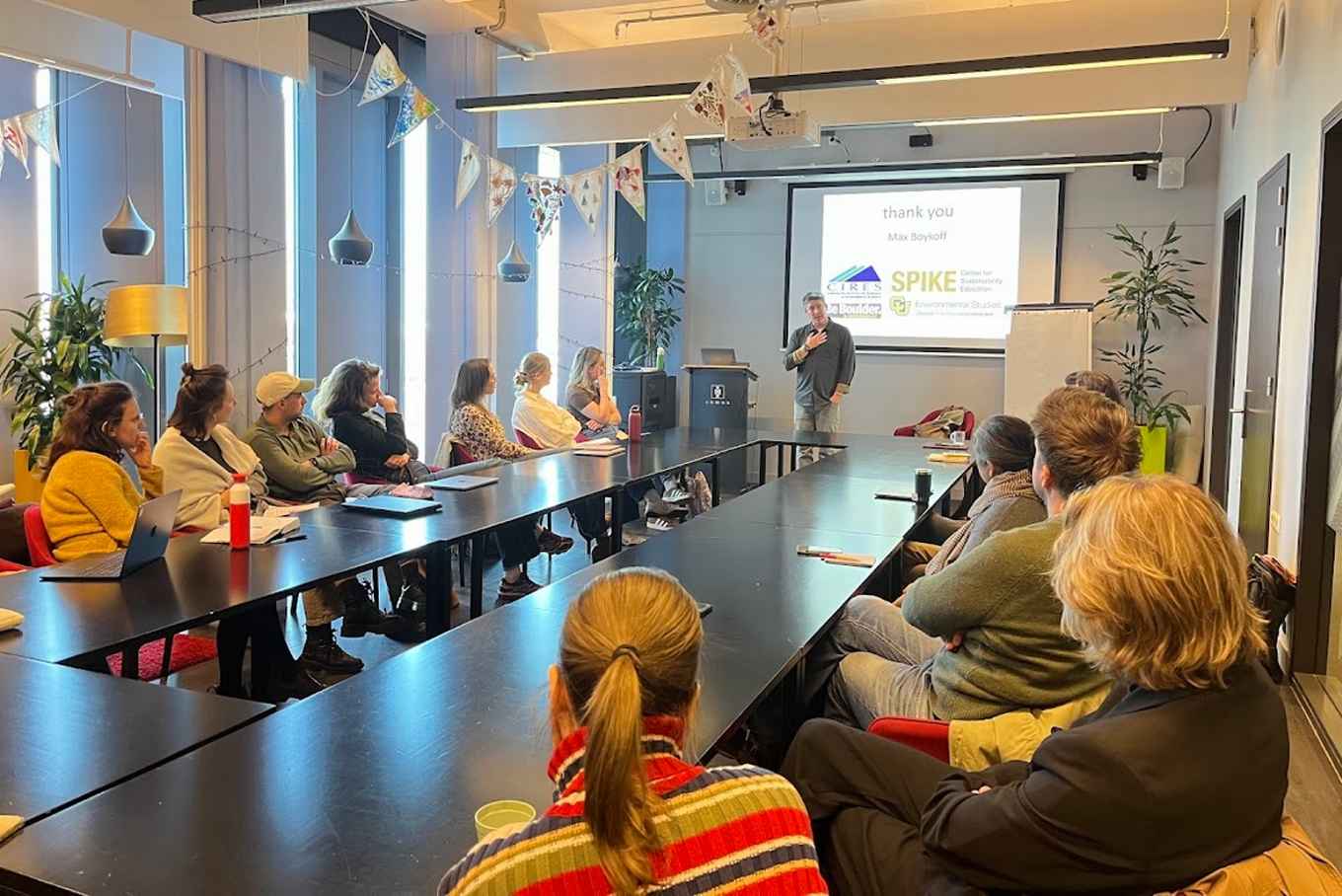
Max Boykoff, Professor in Environmental Studies at the University of Colorado Boulder and Faculty Executive Director of the SPIKE Center for Sustainability Education, opened the session by situating current challenges in climate communication within a broader historical and structural context. Climate change, he argued, cannot be understood as a purely scientific issue. It is entangled with political interests, economic systems, cultural narratives, and moral questions that shape how knowledge is produced and received.
Climate knowledge has evolved
Tracing key developments from the late twentieth century to the present, he pointed to milestones such as early atmospheric CO₂ measurements at Mauna Loa and the ongoing work of the Intergovernmental Panel on Climate Change. These examples illustrated how climate knowledge has evolved alongside persistent tensions around uncertainty, authority, and public trust. Despite decades of increasingly robust evidence, translating awareness into meaningful action remains a central challenge.
Three dynamics to shape public engagement
Drawing on insights from the Media and Climate Change Observatory (MeCCO), a large-scale research project analysing coverage across more than 130 media sources in 59 countries, Boykoff identified three dynamics that continue to shape public engagement: (1) access to reliable information remains uneven across regions and audiences, (2) media attention to climate change has declined in recent years, even as the crisis intensifies and, perhaps most importantly, (3) the persistent gap between what people know and how they act.
Humour becomes not a distraction from the issue, but a way of engaging with it more deeply
In this last matter, Boykoff remarked that, contrary to what we tend to assume, more information does not automatically lead to better decisions.This diagnosis set the stage for a more experimental and forward-looking discussion. If information alone is not enough, how can climate communication evolve? Boykoff’s answer centred on the role of storytelling, narrative, and creative practice.
In particular, he introduced the concept of climate comedy as a way to engage audiences differently and more effectively. At first glance, humour may seem incompatible with the gravity of climate change. Yet, as Boykoff demonstrated, it can play a powerful role in opening up conversations that might otherwise feel inaccessible or overwhelming. Comedy can lower barriers, invite reflection, and create shared moments of recognition. It can also challenge dominant framings and offer subtle forms of critique. In this sense, humour becomes not a distraction from the issue, but a way of engaging with it more deeply.
Through examples from stand up performances and collaborative initiatives, the session showed how climate comedy is already being put into practice. Projects such as Inside the Greenhouse bring together scientists and comedians to co-create content that is both rigorous and engaging. These initiatives are particularly effective in reaching younger audiences and in entering spaces where climate discussions are often absent.
Rethink their approaches to communication, research, and engagement
Importantly, Boykoff did not shy away from the tensions involved. The risk of trivialising the climate crisis is real, and the use of humour requires careful consideration. However, many practitioners see this tension as productive rather than limiting. Comedy can act as a site of subversion, where difficult emotions such as fear, frustration, or fatigue can be processed collectively. It offers a way to overcome isolation and to reframe climate engagement as something shared rather than individual. The strong response from the audience reflected the resonance of these ideas. The lecture was not only informative but also genuinely inspiring, prompting participants to rethink their own approaches to communication, research, and engagement. Discussions continued well beyond the session, with many expressing interests in experimenting with creative formats themselves.
Explore new ways of communicating climate change
The event concluded with an open invitation to take these ideas forward. Whether through storytelling, collaboration, or even stand-up performance, participants were encouraged to explore new ways of communicating climate change. One message stood out clearly: addressing the climate crisis requires not only better data and stronger evidence, but also more imaginative, inclusive, and emotionally engaging ways of telling its stories.