Researching and Teaching Environmental Justice with the EJ Atlas
23 March 2026
Bringing together faculty and students, the workshop moved beyond introducing the Atlas as a database and its potential use for teaching and researching in our different bridged disciplines. In this sense, it positioned the EJAtlas as a methodological and political project: one that maps socio-environmental conflicts while contributing to environmental justice movements and public debates.
A global dataset of collaborative infrastructure
Founded in 2013 at ICTA-UAB, the EJAtlas has grown into the largest global dataset on socio-environmental conflicts. It currently documents over 4,500 conflicts, references more than 6,000 companies and 13,000 organisations, and has inspired over 5,700 academic publications. Since 2024 alone, it has received 180 data requests from researchers, NGOs, and public institutions, and it counts around 500,000 unique yearly users worldwide.
The platform combines narrative case studies with more than 100 coded data fields, enabling both qualitative depth and quantitative analysis. As highlighted during the seminar this hybrid structure allows for:
- Case-based political ecology research;
- Statistical political ecology and large-N analysis;
- Co-production of knowledge with affected communities;
- Targeted policy analysis (e.g. Indigenous rights, biodiversity governance, energy transitions).
At the same time, speakers emphasised the strengths and limitations of heterogeneous data collection. The Atlas relies on diverse sources—media reports, activist documentation, academic research—and is not a primary source. Its governance structure therefore includes moderation protocols and ethical principles to ensure reciprocity and protection for environmental justice movements.
How it started, how it is going
The EJAtlas has progressively moved from mapping environmental conflicts to explaining the deeper structures behind them. Initially, it framed conflicts as struggles over unequal environmental costs along global commodity chains. Over time, it showed these conflicts are systemic, often linked to extractive industries, corporate concentration, and their impacts on Indigenous lands. More recent work highlights how multinational corporations drive these dynamics globally, reproducing unequal exchange patterns, while also emphasising how contested knowledge—such as in pollution cases—shapes environmental justice struggles. The seminar highlighted the breadth and flexibility of the EJAtlas as both a research and teaching tool. Environmental conflicts can be explored across commodities, regions, affected groups, corporate actors, and outcomes, allowing for diverse analytical entry points. Specialised datasets further enable more targeted research, such as recent studies on mining conflicts linked to the energy transition, which reveal how “green” extraction often reproduces long-standing patterns of dispossession. At the same time, emerging research shows that environmental justice movements are not only resisting harm but actively shaping alternatives, including in the field of biodiversity conservation.
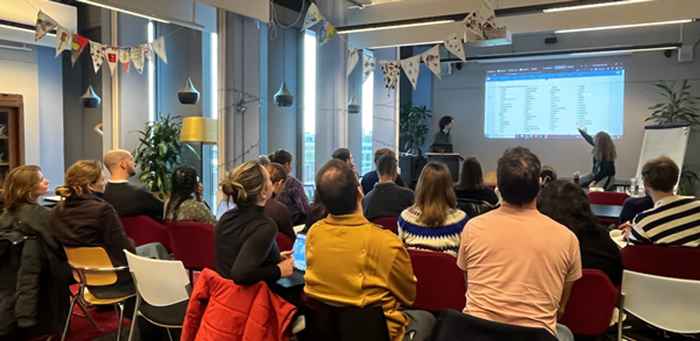
A key focus of the session was pedagogy. The EJAtlas allows students to move beyond passive learning by exploring global cases, tracing commodity chains, and analysing corporate dynamics. Crucially, they can also contribute to the Atlas, developing skills in research, critical reflection, and ethical storytelling. This hands-on approach bridges theory and practice, positioning students as active participants in knowledge production.
Beyond academia, the EJAtlas is increasingly informing policy debates, with its data used by international institutions and contributing to discussions on resource governance, environmental defenders, and global biodiversity agendas.
Value for our interdisciplinary sustainability approach
The CSDS seminar made clear that the EJAtlas operates at the intersection of research, teaching, and activism. It combines large-scale quantitative analysis with situated case narratives, corporate tracking with Indigenous rights advocacy, and academic publications with movement co-production.
In doing so, it challenges narrow sustainability metrics by foregrounding conflict, power, and inequality. For students and researchers at CSDS, the workshop opened a methodological and political horizon: to use the EJAtlas not only as a source of data, but as a space of collaboration, critical inquiry, and solidarity.

In doing so, it challenges narrow sustainability metrics by foregrounding conflict, power, and inequality. For students and researchers at CSDS, the workshop opened a methodological and political horizon: to use the EJAtlas not only as a source of data, but as a space of collaboration, critical inquiry, and solidarity.
About the article
This article is written by Ariadna Romans i Torrent, PhD candidate at the CSDS (UvA) with the notes and support of Dr Mariana Walter and Dr Marcel Llavero-Pasquina from the team of the Environment Justice Atlas.