What humans disrupted, water reconnected: Reflections from Makassar, Indonesia
14 January 2026
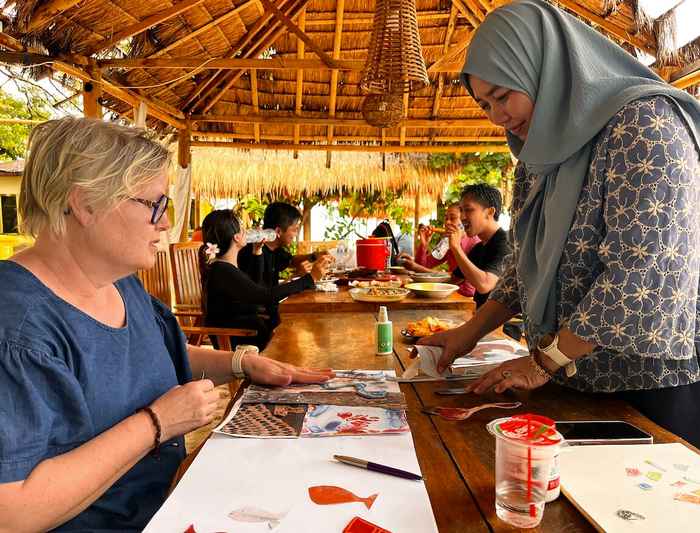
Three different shores, one common (hi)story
In 1652, Dutch colonial agents from the Vereenigde Oostindische Compagnie (VOC) established a refreshment station at the Cape of Good Hope on the route to what they named as Batavia, currently Indonesia. This initiated a long chain of exchanges that linked what are now South Africa, Indonesia, and the Netherlands. These connections were often shaped by extraction, racialised labour, and the reconfiguration of coastal and urban space. Their traces remain visible today in the built environments of Cape Town, Makassar, and Dutch cities, as well as in contemporary forms of tourism, trade, and environmental pressure.
This workshop was developed by four PhD candidates (Emily, Amanda, Butet, and Ashry) at the University of Amsterdam, each rooted in different geographies and research traditions across these three regions. Their collaboration aimed to examine how water offers a perspective for understanding these historical entanglements and the present-day challenges of climate change. The workshop took place from the 11th to the 16th of November 2025 in Makassar, Sulawesi, Indonesia.
Makassar: A city of layers and transitions
Makassar, on the island of Sulawesi, is a city marked by rapid construction and limited public space. Iconic landmarks such as the bright orange mosque with ninety-nine towers coexist with large commercial developments built on reclaimed land along the coastline, a technique learnt from the Dutch, which have transformed the area in recent years. The city stands as a vivid example of how urbanisation, capital flows, and environmental uncertainty intersect in shared grounds and geographies.
Most of the workshop took place at Hasanuddin University’s Marine Station in Barang Lompo Island, a location directly affected by rising sea levels, seasonal storms, and changes in fishing grounds. The rainy season, which began during the workshop days, provided us an immediate backdrop for reflecting on how local communities face water vulnerability with a mix of resistance, resignation, and resilience.
Day One: Situating water (Hi)stories
The opening day focused on colonial water entanglements. Professors from anthropology, geography, and history presented research on maritime routes, Dutch interventions in local waterscapes, and forms of extraction that shaped both South Africa and Indonesia. In this setting, participants explored archival material and maps, discussing how past infrastructure continues to influence present day environmental challenges.
Throughout the day, the value of bridging academic disciplines became clear. This combination of perspectives laid the foundation for the workshop’s collective outputs, which included a variety of arts-based research methodologies and creative documentation.
Day Two: Storying entanglements through water bodies
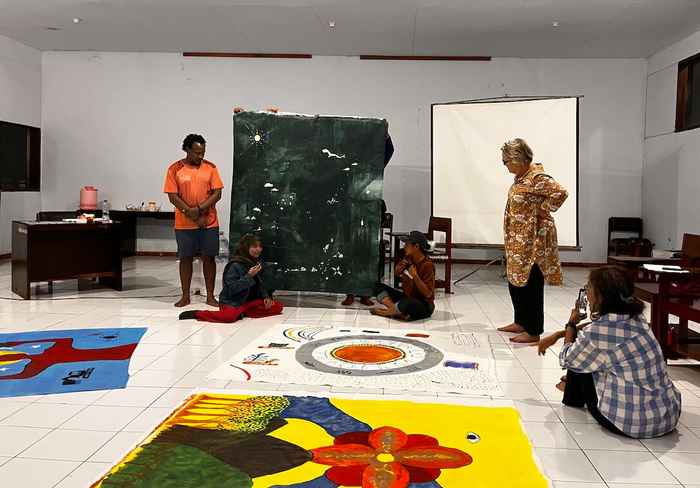
The second day introduced artistic methods that encouraged participants to entangle personal and community narratives. Through photovoice, sculpting, and shared water stories, groups worked with concepts of vulnerability, trust, and memory in a blank canvas that they had to fill with colours, shapes, and combinations that represented those stories.
This activity created an environment where knowledge was produced collaboratively and where scientific and artistic practices were treated as complementary.
Day Three: Slow-motion reflection on reclaimed land
The third day of our workshop began with a return to Makassar, where we visited the Center Point of Indonesia. Walking through this reclaimed shoreline made visible the complexities of coastal redevelopment. Once a neighbourhood of fishing families, it has been turned into a commercial district, and the transformation displaced thousands of residents.
Later, on Samalona Island, we held the stop-motion workshop, creating a space to slow down and reflect on the stories and impressions gathered throughout the week. Participants also engaged with local initiatives, including an informal school founded by educator Butet Manurung. The school supports children affected by reclamation projects, and meeting its team made clear how environmental change and social inequality become tightly intertwined.
The day unfolded as a moment of listening and mirroring water stories, helping us understand how shifting seascapes shape the everyday realities of the communities who live with them.
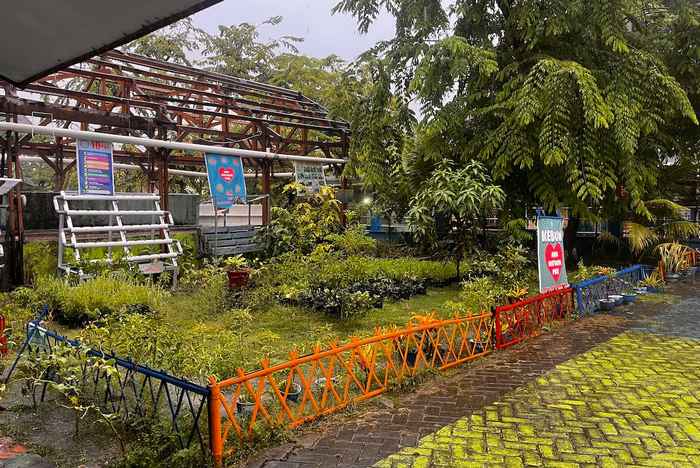
Day Four: Filming and diving on collective futures
The last day of our workshop began on Samalona Island, where the morning light caught the edge of the water as we prepared to return to Barang Lompo. There, participants joined a coral transplantation activity guided by divers from Wakatobi. As we worked alongside them, the significance of restoration became tangible: corals nurturing local food systems, and communities finding ways to adapt to increasingly disrupted waterscapes.
The activity created a quiet bridge between our conversations over the past days and the living seascape around us, offering an embodied reminder of the futures we had been imagining together. As the sun began to set, we left the island and made our way back to Makassar, where the workshop closed with a warm farewell dinner shared by all.
What Makassar revealed: Tracing water across histories, geographies, and bodies
The workshop in Makassar demonstrated how water can serve as a connector across places shaped by very different histories. Participants reflected on the importance of South South knowledge exchange, the potential of storytelling to reframe dominant environmental narratives, and the need to recognise knowledge produced in the Global South as scientifically relevant. Arts-based methodologies were central throughout. They made space for visual forms of storytelling and drew attention to how stories move through histories and bodies often carrying meanings that situ outside of formal academic language.
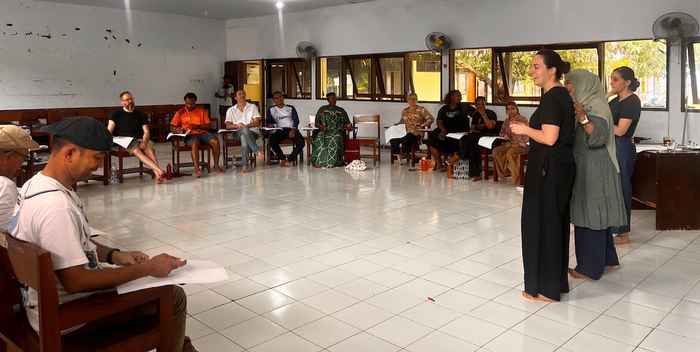
Across four days, academic analysis, artistic practice, and community engagement came together to produce new ways of understanding environmental change. The workshop showed that when narratives, methods, and experiences circulate across regions, water becomes not only a subject of study but a teacher that reveals how climate pressures are shared, resisted, and transformed.
About the authors
Amanda Mokoena, Emily Ragus, Ashry Sallatu, and Butet Manurung are PhD candidates at the Department of Anthropology at the University of Amsterdam. Ariadna Romans is a research assistant at the Centre for Sustainable Development Studies (CSDS).