Repairing the City: Labour, Knowledge, and the Future of Water in Mexico City
By Ariadna Romans i Torrent and Sofie Carpaij
5 December 2025
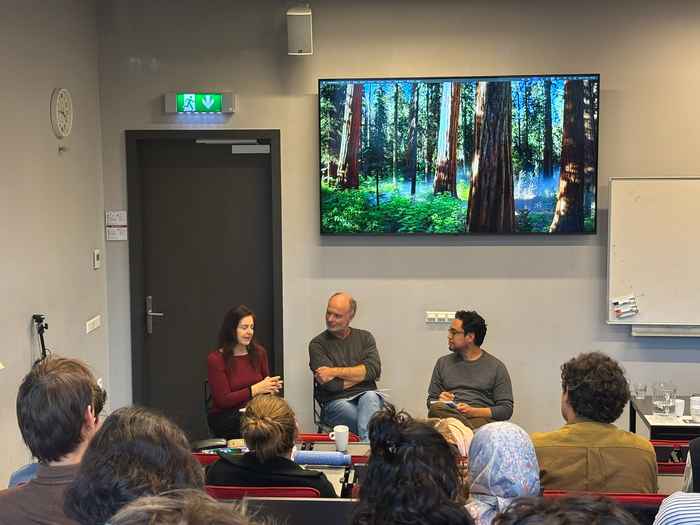
His talk invited us into the often-invisible world of the people who keep Mexico City’s vast and fragile water system functioning. Drawing on ten years of ethnographic research inside the public water utility, Alejandro shifted our attention from pipes and masterplans to the workers whose daily decisions, creativity, and improvisations hold the system together.
We began with a striking visual journey into the Cárcamo de Dolores, built in the mid-20th century and adorned with Diego Rivera’s murals. Conceived as a celebration of a modern, socially just metropolis, the space places workers at the centre of progress and technological achievement. Alejandro used this historical symbol to pose a simple but powerful question: who are the workers responsible for the city’s water today, and what does their labour actually look like? What followed was a deep dive into the everyday realities of hydraulic modernity—realities that diverge sharply from Rivera’s idealised portrayals.
Most of Mexico City’s water workers spend their days responding to leaks, urgent calls from residents, and unpredictable breakdowns in the system. Rather than relying on comprehensive data or technical precision, much of their work depends on embodied knowledge, accumulated experience, and improvisation. Water-flow measurements, for instance, tend to be reliable only in wealthier, central districts. In peripheral neighbourhoods, workers often operate through speculation, intuition, and collective memory—reading sounds, textures, or pressure changes to understand what is happening below ground. This everyday labour is not simply maintenance. Alejandro showed how workers’ decisions constantly reshape the infrastructure itself: residents demand quick solutions; workers modify the grid in response. With every improvisation, the network changes. This raises important questions about who truly designs the system and how technical power is exercised on the ground.
Alongside this ingenuity, Alejandro highlighted the mounting pressures undermining Mexico City’s water system: deepening austerity and budget cuts, increasingly irregular rainfall patterns, chronic overextraction of aquifers, and the physical sinking of the city. These constraints magnify existing inequalities in water distribution, making the system more fragile and unpredictable. Yet, despite these challenges, the system continues to function—largely because workers keep repairing it, designing temporary workarounds and inventing new solutions every day.
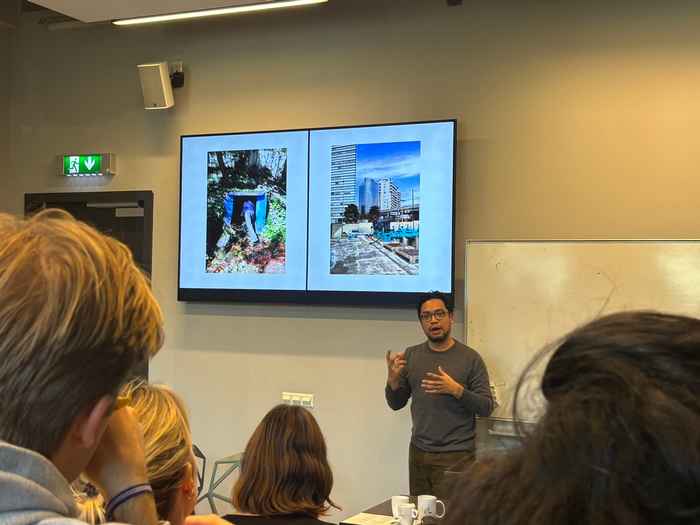
By foregrounding the experiences and knowledge of workers, Alejandro invited us to reconsider what we mean by hydraulic modernity. The heroic images painted by Rivera clash with the precarious realities of today. However, paying attention to workers’ labour also opens space for imagining different futures—ones that recognise the people who sustain the city rather than erasing their contributions behind technical abstractions.
The session concluded with insightful comments from Maria Kaika (UvA) and Rutgerd Boelens (WUR & UvA), followed by an engaging discussion that continued informally at CREA. Looking back at this seminar, one theme stood out repeatedly: the urgent need to understand water infrastructures not only as technical systems, but as living, contested, and labour-intensive worlds. Alejandro’s work reminds us that the future of urban water depends as much on people as on pipes.